


Dispatchers can communicate with drivers and other active SCALAR platform users by using the Messaging module. You can send direct messages, create broadcast channels, and add attachments for reference.
Create a message #
You can create conversations or broadcast messages based on the number of recipients.
- From the left navigation pane > click Messaging
 . The messaging page is displayed.
- In the Conversations pane, Click New. The conversation type list is displayed.
 . The messaging page is displayed.

| Message type | Description |
| Conversations | Direct communication with a user |
| Broadcast message | Broadcast a message to multiple users |
Conversations #
You can send direct messages to drivers and other users without adding multiple participants to a conversation.
- From the message type list, select Conversations. The Contacts pane is displayed.
- Select the required contact from the list. The message window for the selected contact is displayed.
- In the Type a message box, enter a message, and then click Send . The message is sent and a conversation history is created.
 . The message is sent and a conversation history is created.

Send Priority message #
Sending a standard message will not generate a sound on the on-board computer when it is set to Rest, and will not wake up the driver.
However, you can also send a priority message to a driver, if enabled. Use this for urgent information that requires immediate attention. This will trigger an audible alert to ensure the driver is awakened or notified instantly.
Next to the message box, an exclamation icon is visible. Click the icon to enable a priority message. The icon will be highlighted in red, and Priority will be displayed above the message box:

Currently, this feature is only supported on SCALAR EVO Touch devices.
Search for conversations #
You can search for a conversation with a contact.
- From the left navigation pane > click Messaging . The messaging page is displayed.
- From the Conversations pane, enter a name of the contact or the message in the Search box. The search results list is displayed.
- Select the required contact/group conversation/message from the list. The selected contact/group conversation details are displayed in the individual conversation details. For matching messages, when selected, the user will be auto-scrolled to the message within the conversation and the matching message will be highlighted.
Search results will be displayed in 2 sections: Conversations, displaying the contacts and group conversation names that match the search term(s) and Messages, highlighting the message keywords that match the search term(s) within the existing conversations.
This is applicable for the web application and the driver app.

Enter at least three characters to initiate a search operation.
Broadcast message #
You can use the Broadcast message function to send a common message to multiple contacts or vehicle group conversations.
- In the Conversations screen, click the New button. From the conversation type list, select Broadcast message. The Broadcast message page is displayed.
- First, use the toggle button to switch between Contacts and Vehicles (you cannot broadcast to both at the same time).
- Next, enter information in the various sections: Add contacts/vehicles, Message body, and Attachments, and then click Send. The message is broadcast.

Contacts/Vehicles #
You can add selected or all active contacts (users/drivers) or vehicles to the broadcast.
In order to have both options (Contacts/Vehicles) available, your organization must have an active subscription to the SCALAR PRO package. The administrator can enable/disable either of the options in Settings management (cf. Configure messaging service). In that case, the disabled option will only be available to the administrator, not the normal users.
- When selecting Contacts, click Add contacts/vehicles. The Add contacts page is displayed.
- Click Add
 to select the required contacts from the available list. The selected contacts are added to the right pane.
- Click Save. The required contacts are added to the contacts section.

- Click Add
- When selecting Vehicles, click Add contacts/vehicles. The Add vehicles page is displayed.
- Click Add to select the required vehicles from the available list. The selected vehicles are added to the right pane.
- Click Save. The required vehicles are added to the vehicles section.

- To add all available contacts/vehicles in one action, click Add all on the available pane.
- The current user must be assigned to the vehicle / vehicle group (or subgroup) in order to be able to add it here.
- To remove the added items from the right pane, click Remove
 next to the item.
- To remove all added items from the right pane in one action, click Remove all.
- Use the filter options for:
- Contacts: to filter between users and drivers.
- Vehicles: to filter on groups and subgroups.
- You can add up to 300 contacts/vehicles.
- You can either add contacts or vehicles to the broadcast, not both. In case items have already been added, and you want to switch to the other category, the items will be removed:

 to select the required contacts from the available list. The selected contacts are added to the right pane.


 next to the item.

Message body #
In the Message body section, in the Type a message box, enter the required message.
The message body can contain a maximum of 3000 characters.
Attachments #
You can attach images and PDF file for the reference of the recipients.
- In the Attachments section > click Add attachment, and then select Image or PDF from the attachment type list. The File explorer is displayed.
- Select the required file, and then click Open. The attachment is added.
- To remove all the files added, click Remove all.
- You can attach multiple image/PDF files in a single broadcast message.
- You can only attach either of the file formats in a single broadcast message, for example, if you add an image file, the PDF option is unavailable.
- The maximum allowed file size for images or PDFs is 25 MB.
- Click Send. The message is broadcast and a broadcast channel is created.

View messages #
You can view both direct conversations and broadcast messages on the Conversations pane.
In the Messaging module > on the Conversations pane, select the required message from the list. The message window is displayed.
Manage messages #
In a message window, you can search for message keywords, or use the options menu to recall messages, add favorites, reply, and mark a conversation as unread.
In the Messaging module > on the Conversations pane, select the required contact from the list. The message window is displayed.
Add to Favorites #
You can mark important messages as favorites (within the same conversation) for ease of search.
- In the message window, hover over a message. The Menu
 is displayed next to the text message.
- Click Menu , and then click Add to favorites from the list. The selected message is starred.

View favorite messages #
To view all messages marked as ‘Favorite’ within the selected conversation, click the menu icon  , at the top next to the Search icon, and then click Favorite messages from the list. All the starred messages within the current conversation are displayed on the Favorite messages pane.
Go to message #
In the list of favorite messages, click Menu  , and then click Go to message to view the favorite message with the current conversation.
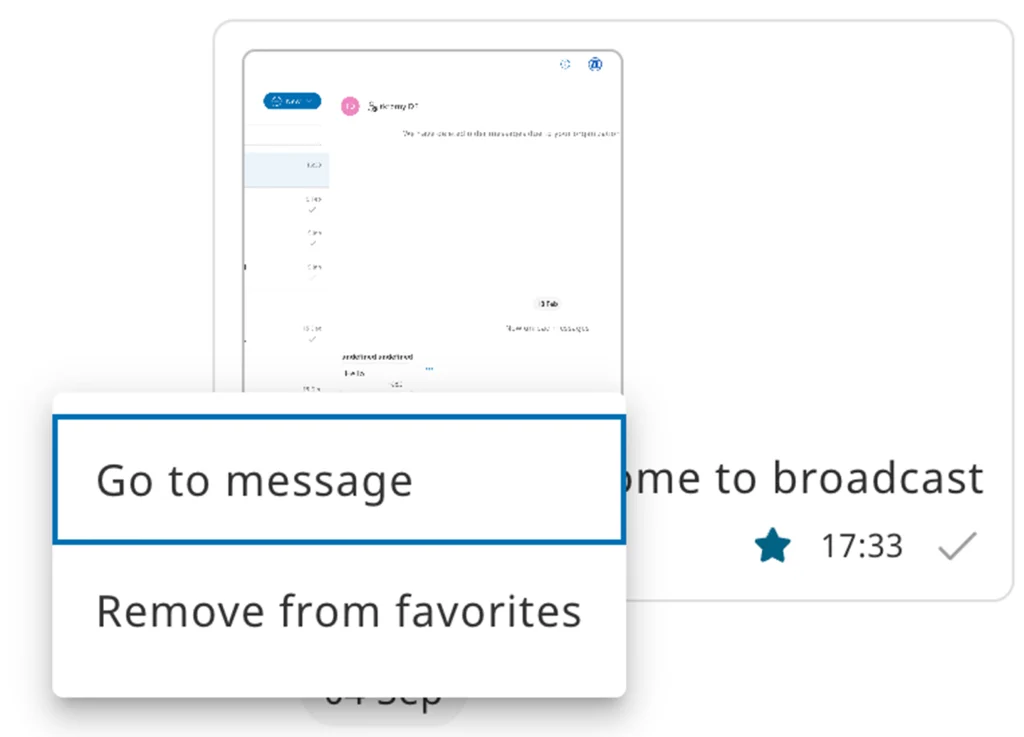
Remove from Favorites #
If a message is not important anymore, you can remove it from the favorites.
Hover over a starred message, click Menu , and then click Remove from favorites from the list. The message is removed from favorites.

Mark as Unread #
If you do not want to notify the sender that you have read the latest message, you can mark a conversation as unread.
In the message window, click Menu , and then click Set unread from the list. The conversation is marked as unread.

A red dot is displayed on the messages marked as unread.
Recall message #
Sent messages can be recalled to avoid miscommunication.
- In the message window, hover over a message. The Menu icon is displayed next to the message.
- Click the Menu icon, and then click Recall message from the list. The recalled message is no longer displayed in the conversation history.

Reply to a message #
You can reply to a message sent by a contact.
- In the message window, hover over a message. The Menu icon is displayed next to the message.
- Click the Menu icon, and then click Reply from the list. The Type a message box is displayed.
- Enter the message, attach a file if required, and then click Send . The message is sent and a conversation history is created.
Search a message #
You can search for specific messages in a conversation by searching a keyword.
- In the message window, click Search . The Search pane is displayed.
- In the Search box, enter a keyword to initiate the search. The messages matching the search criteria are displayed.
This is applicable for the web application and the driver app.
 . The Search pane is displayed.
Enter at least three characters to initiate a search operation.

Save media files locally #
From the Messaging module, you can save PDFs and image files to your local devices for future reference. These files can be accessed any time, even offline.
This functionality is available to desktop users—mainly back-office users or dispatchers who will be accessing the web app.
Download an image
- In the messaging window, hover over an attachment. The Menu is displayed next to the attachment.
- For a single image, click the Menu icon, and then click Save to device from the shortcut menu. The file is saved to the Downloads folder.
- To download an image from a group, click the required image from the group, and then click the download icon that appears on the upper-right corner. The selected image is downloaded.


To download all the images from a group, hover over the group to view the Menu , and then click Save to device.
Download a PDF
In the messaging window, click the PDF attachment. The file is automatically saved to the Downloads folder.
If a driver clicks the PDF, it opens in the driver (native) app provided that a PDF-reader is installed. An image can be previewed but cannot be downloaded due to security reasons.
View message notifications #
You can view recent unread messages on the Notifications pane in the upper right corner of the header row on the SCALAR platform.
For more information about how to view and configure notifications, see Notifications.
Group conversations per vehicle (SCALAR PRO package required) #
Next to direct messaging, organizations with the SCALAR PRO package also have group messaging available. This allows communication between dispatchers and a driver and its vehicle in a grouped conversation. Back-office users are automatically added to a dedicated group chat for each vehicle/asset they track.
Group messaging must be enabled by the administrator in Admin > Settings.

Chat with vehicle #
When active, all dispatchers that track a vehicle/asset have access to a group conversation per tracked vehicle/asset. The group conversations are created automatically in the Messaging module.
Chat with driver #
Drivers can access the group conversations as soon as they are linked to the vehicle by manually selecting the vehicle in Cargo app or by inserting the tacho driver card into the tachograph. @@@Link to cargo app
Select an asset in the Assets list to open the detail pane.
When an asset is linked to a driver (via manual vehicle selection or tacho card insertion – See Link driver to asset), a message icon is available in the upper right corner of the detail pane. Click the message icon to open the Messaging module.
In the Messaging module, a group chat is available for that specific driver, vehicle and any dispatchers that follow the vehicle.

Notifications related to group conversations #
A notification will be displayed in the Notifications pane in the upper-right corner when a driver sends a message for all users that track the asset.
The notification will be set to Treated for all users when any user in the group conversation treats the message.
Network requirements #
SCALAR uses real-time connections for messaging in addition to standard HTTPS traffic. These chat connections require dedicated outbound ports to be allowed on the customer network. If these ports are blocked, chats may have issues loading.
To ensure a successful setup, ask your IT team to set up your network and allow outbound traffic on the non-standard ports listed below.
|
Client |
Port |
Protocol |
Purpose |
|---|---|---|---|
|
Web app |
5280 |
WSS (TLS) |
Real-time chat (XMPP over WebSocket) |
|
Mobile app (SCALAR Cargo) |
5222 |
XMPP (STARTTLS required) |
Real-time chat |
|
Web + mobile |
443 |
HTTPS |
Registration, contacts, media APIs |


