Skip to content
scalar help center
  • Browse articles
    MULTI_LETTERS_1024px_CYAN
    User documentation

    Provides instructions, guidance and information

    TECHNCAL_INFORMATION_1024px_CYAN
    Hardware installation guides

    Guides the installer through the hardware installation

    Developer documentation

    Serves a crucial resource for software developers

Get support
  • Logout

Login
  • Select Region and Language

    Europe, Middle-East and Africa

ZF

Search

User Documentation

  • Cargo transport
    • Welcome to SCALAR
    • Getting started
    • Home
      • Fleet view
      • Map overview
      • Alarms
      • Messaging
      • Trips
      • Route planner
      • Tachograph
      • Infringements
      • Duty time
      • Brake performance
      • Reefer insights
      • Eco performance
      • Asset insights
      • View and manage driver documentation
      • Fuel drops
      • Data sharing – manage sessions
      • Manufacturer reports
      • Reports
      • Map
        • Monitor assets
        • Monitor drivers
        • Manage and monitor places
      • Reports
        • Custom reports
    • Administrator
      • Capability Configurator
      • User management
      • Unit management
      • Asset management
      • Resource combinations
      • Place management
      • Group management
      • Team management
      • Integrator management
      • Settings management
      • Configure alarm rules
      • Driver management
      • Configure tachograph settings
      • Activities
      • Define document types and configure profiles
      • Data sharing – agreement and contract creation
      • Subscription renewal of telematic services
      • Audit logs
      • Impersonation
    • Spot subcontracting
      • Spot subcontracting – Getting started
      • Integrator – Datahub API
      • Driver – Webform
    • Account
      • Notifications
      • Profile management
    • SCALAR Cargo App for Drivers
      • SCALAR Cargo App for Drivers
      • Driver login methods
      • Activities
      • Messaging
      • Schedule
      • Upload documents
      • Service time
      • Settings
    • Datahub
      • Rest API
      • Webhook developer metrics
      • Raw Message Streaming (RMS)
      • Datahub subscription
      • Datacoins
    • Workshop
      • Workshop
      • SCALAR EVO Guard
      • SCALAR EVO Pulse
      • SCALAR EVO Flow / Touch / Flow (v2)
    • Customer portal
      • Unit subscription
      • View subscription information
      • Invoices
      • Manage child organizations
    • Support
      • Reach out to Customer Support
      • My repairs
    • Service
      • OTA manager
    • Data privacy
      • Data Privacy
    • ASK AI
      • ASK AI: AI-Driven Migration Assistant
  • Passenger transport
    • Basic concepts
    • Setup organization
    • What is Passenger transport?
    • Configure transportation service
    • Plan your operations in SCALAR
    • Configure transportation service
      • Manage your transportation services in SCALAR
      • Customization of the Traveler App
      • Publication of new Traveler App versions to the stores
      • Traveler App and Driver App release process
    • Operating the transportation service
      • Monitor your operations in SCALAR Dispatching view
      • Your step-by-step guide for handling operational incidents
      • Place a booking on behalf of a traveler
      • Communicate with your travelers
      • Operations Support Flow
    • Release notes
      • Traveler App Android
      • Traveler App iOS
      • Driver App
      • Web App
  • Software Update Management System (SUMS)
    • Welcome
    • Getting started with SUMS
    • Welcome and get started with SUMS
    • SUMS dashboard
    • SUMS viewer
    • Update vehicle information
    • Software package distribution through Workshop
    • Software package download during EOL production
    • Software package management   
    • Vehicle type management
    • Vehicle management
    • Glossary: Software Update Management System
  • Public Key Infrastructure
    • SCALAR Public Key Infrastructure SaaS Solution

Hardware Installation Guides

  • SCALAR EVO Touch
  • SCALAR EVO Cast
  • SCALAR EVO Flow
  • SCALAR EVO Guard
  • TrailerCast with Battery
  • SCALAR EVO Pulse
  • Home
  • Docs
  • User Documentation
  • Cargo transport
  • Administrator
  • Team management
View Categories

Team management

Updated on July 6, 2026
URL copied to clipboard!

Permissions to access users, integrators, asset groups, place groups, and driver groups can be effectively managed through the Teams module.

A resource group (asset group, driver group, and place group) can be linked with teams. Only users and integrators can be assigned directly to teams. Resources such as assets, places, and drivers cannot be linked with teams directly.

NOTE:
  • A team can be described as a user group.
  • When a resource group is linked with a team, resources such as assets, drivers, and places are in
  • A resource group can be assigned to multiple teams.
  • Access to a parent group also provides access to its child groups. For example, when a resource group is linked with a team, access to all the resources of the group is assigned to users of the team. The access to all the resources of the subgroup is also assigned to users of the team.

In an organization, groups are structured in such a way so as to follow all the resources. An administrator can group assets, places, and drivers to organize the resources within SCALAR.

NOTE:
  • Max. 1000 teams can be created in an organization
  • Max. 25 teams can be assigned to a user
  • Max. 100 groups and subgroups can be assigned to a team
  • Max. 5000 resources can be assigned to a resource group (including subgroups)

Add a Team #

You can add a team, assign users and integrators, and assign resource groups such as asset groups, place groups, and driver groups.

NOTE:

This functionality is subject to user permissions. Only an administrator can access the Admin module.

  1. In the Admin module > click Teams . The Teams page is displayed.
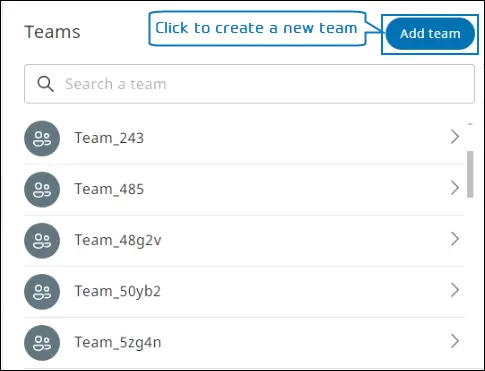
  2. Click Add team. The Add team dialog is displayed.
  3. NOTE:

    Max. 1000 teams can be created in an organization. Should the number of teams exceed this count and a new team must be created, an existing team will need to be deleted.

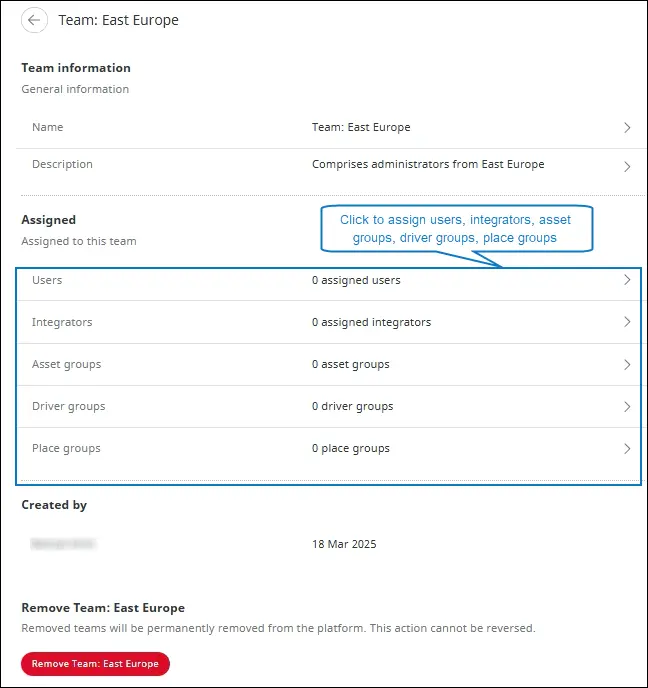
  4. In the Name box, enter a name, in the Description box, enter additional information, and then click Save. A message is displayed confirming that the team is created and the user is directed to the team details page. The name and description are auto-filled in the Team information section.
  5. In the Assigned section, assign users, integrators, asset groups, place groups, and driver groups.


    The table below explains the actions that can be performed in the Assigned section.

Field

Action

Users

  1. Click Users. The page containing various tabs to assign resources is displayed. The users are listed in the Available users list.
  2. To assign a user to the team, select the required users from the Available users list. Alternatively, in the Search users box, enter the name of the required user, and then press Enter.
  3. Click Assign next to the user name. The user is listed in the Selected users lists.
  4. Click Save. The user is assigned to the team.

Integrators

  1. Click Integrators. The integrators are listed in the Available integrators list.
  2. To assign an integrator to the team, select the required integrators from the Available integrators list. Alternatively, in the Search integrators box, enter the name of the required integrator, and then press Enter.
  3. Click Assign next to the integrator name. The integrator is listed in the Selected integrators list.
  4. Click Save. The integrator is assigned to the team.

Asset groups

  1. Click Asset groups. The asset groups are listed in the Available asset groups list.
  2. To assign an asset group to the team, select the required asset group from the Available asset groups list. Alternatively, in the Search for asset groups box, enter the name of the required asset group, and then press Enter.
  3. Click Assign next to the asset group name. The asset group is listed in the Selected asset groups lists.
  4. Click Save. The asset group is assigned to the team.
  5. To trace the hierarchy from where the asset group or an asset subgroup is assigned, in the Selected asset groups section, click the Locate  icon next to the asset group name. The asset group or subgroup from where the selected resource is derived is highlighted in the Available asset groups section.

Driver groups

  1. Click Driver groups. The driver groups are listed in the Available driver groups list.
  2. To assign a driver group to the team, select the required driver group from the Available driver groups list. Alternatively, in the Search for driver groups box, enter the name of the required driver group, and then press Enter.
  3. Click Assign next to the driver group name. The driver group is listed in the Selected driver groups lists.
  4. Click Save. The driver group is assigned to the team.
  5. To trace the hierarchy from where the driver group or a driver subgroup is assigned, in the Selected driver groups section, click the Locate  icon next to the driver group name. The driver group or subgroup from where the selected resource is derived is highlighted in the Available driver groups section.

Place groups

  1. Click Place groups. The place groups are listed in the Available place groups list.
  2. To assign a place group to the team, select the required place group from the Available place groups list. Alternatively, in the Search for place groups box, enter the name of the required place group, and then press Enter.
  3. Click Assign next to the place group name. The place group is listed in the Selected place groups lists.
  4. Click Save. The place group is assigned to the team.
  5. To trace the hierarchy from where the place group or a subgroup is assigned, in the Selected place groups section, click the Locate  icon next to the place group name. The place group or subgroup from where the selected resource is derived is highlighted in the Available place groups section.

Teams for integrators
Assets can be leased to multiple clients, which introduces the potential risk of exposing sensitive information to unauthorized users while sharing data across these clients.  The Teams for Integrators feature provides a granular level of data access, ensuring that integrators can only access information related to resource groups assigned to their respective teams. This approach maintains confidentiality and prevents inadvertent data breaches. By restricting integrators to access only data relevant to their assigned groups, this feature ensures data privacy and strengthens security.

After assigning users, integrators, asset groups, driver groups, and place groups to the team, the total number of resources assigned to the team are displayed in the Assigned section on the Team information page.

NOTE:

Max. 5000 resources can be assigned to any resource group or subgroup. A user can follow a maximum of 25 teams x 100 groups x 5000 of each resource type (assets, places, drivers).

Edit Team Details #

From the team information page, you can edit team details such as general information and resources assigned, if required.

  1. In the Admin module, click Teams . The Teams page is displayed.
  2. Select the required team. The team details page is displayed containing the following editable sections:
    • General information
    • Assigned
  3. Go to the relevant section, click the required fields, and then modify the information. The updated information is saved. For more information about each field, see Add Team.

View Teams #

You can view the list of teams created on the SCALAR platform and manage access to resources from the Teams page.

  • In the Admin module > click Teams . The Teams page is displayed with the list of teams.

Search a Team #

You can search a team on the Teams page by using the Search feature.

  • In the Admin module > click Teams . The Teams page is displayed. In the Search a team box, enter the team name. The user records matching the search criteria are displayed.
  • NOTE:

    Enter at least three characters to start a search operation.

Remove a Team #

You can remove a team from the Teams page if it is no longer required.

  1. In the Admin module, click Teams . The Teams page is displayed.
  2. Click the team name. The team details page is displayed.
  3. Click Remove <team name>. The Delete team dialog is displayed.
  4. Click Delete. The record is permanently removed from the SCALAR platform.

Give us some feedback

Was this article useful?

What are we doing well? (0/1000)

Character limit reached

Feedback cannot be empty.

If you need help from Support, you can submit your query at zf-scalar-servicedesk@zf.com.

Thanks for your feedback!

Log in to leave a feedback

Or

Group managementIntegrator management
Table of Contents
  • Add a Team
    • Edit Team Details
  • View Teams
  • Search a Team
  • Remove a Team
ZF

SCALAR is ZF’s pioneering Fleet Orchestration Platform (FOP). ZF is a global technology company supplying systems for passenger cars, commercial vehicles and industrial technology, enabling the next generation of mobility.

More about ZF

Articles

User documentation
Hardware documentation
Developer documentation

Get in touch

Join our team
Get support
FAQ
SCALAR developers

Cookie Settings

Imprint

Data Protection

© ZF CV Systems Global GmbH

Search

    EMEA

    Americas

    APAC

    India

    Browse Articles

    User Documentation
    Hardware Documentation
    Developer Documentation

    Get Support
    Login
    • [region_toggles layout="vertical"] [custom_flag_menu_script]